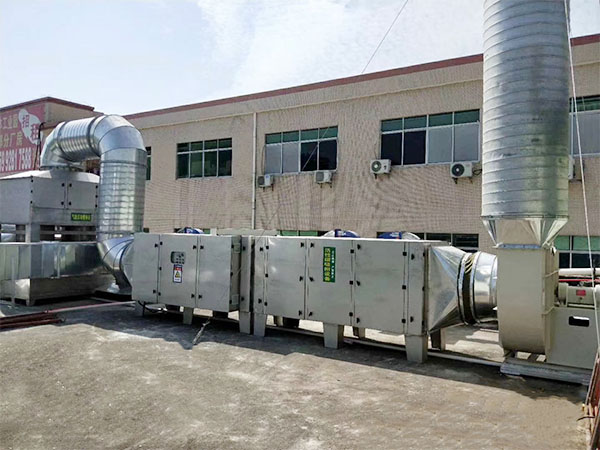
1. VOCs exhaust gas treatment equipment, absorption type exhaust gas treatment equipment: The absorption method uses low-volatile or non-volatile solvents to absorb VOCs, and then separates them based on the differences in physical properties between VOCs and the absorption agent. The gas containing VOCs enters the absorption tower from the bottom and, during its upward movement, comes into countercurrent contact with the absorption agent from the top of the exhaust gas treatment equipment. The purified gas is then discharged from the top of the tower.
II. Combustion and Catalytic Purification Equipment: The principle is to use an excessive amount of air to cause these impurities to burn. Most of them will be converted into carbon dioxide and water vapor, which can be discharged into the atmosphere. However, when dealing with organic compounds containing chlorine and sulfur, the combustion-generated products contain HCl or SO2, and further treatment of the post-combustion gas is required.
III. Adsorption-type Waste Gas Treatment Equipment: When treating waste gas through adsorption, the adsorption target is gaseous pollutants, which is a gas-solid adsorption process. After a period of adsorption, due to the concentration of adsorbate on the surface, the adsorption capacity significantly decreases, and the adsorbent needs to be regenerated. Therefore, in actual adsorption engineering, it is precisely by utilizing the cycle of adsorption - regeneration - re-adsorption to remove the pollutants in the waste gas and recover the useful components in the waste gas.
IV. Oxidation Waste Gas Treatment Equipment: The LTAOP advanced oxidation technology uses the AOP method to treat malodorous gases. After hydroxyl radicals perform sterilization, disinfection, and odor removal on organic substances, their final products are CO2, H2O, and harmless carboxylic acids. Apart from power consumption and water consumption, no other raw materials are consumed, no secondary pollution is caused, and no secondary treatment is required.
VOCs exhaust gas treatment equipment is professionally manufactured by Jiangsu Junuo. It ensures quality and offers competitive prices.
Which types of exhaust gases does VOCs control mainly?
After implementing appropriate methods for VOCs treatment, the industrial waste gases produced by various chemical and smelting enterprises can achieve compliance with emission standards. Therefore, the most advanced VOCs treatment technologies and related equipment are an effective measure to ensure that the atmospheric environment is not polluted. So, what are the main types of gases that currently require VOCs treatment?
Spray painting exhaust gas
The main components of this type of spray paint exhaust gas include some volatile organic compounds such as acetone, xylene, butanol, toluene, ethyl acetate, and butyl acetate. This type of spray paint exhaust gas mainly exists in industries that require paint spraying. For spray paint exhaust gas, given its large volume and low concentration characteristics, the commonly used VOCs treatment method is the molecular sieve rotor + regenerative incineration technology.
2. Plastic and synthetic resin waste gas
The main cause of plastic and rubber waste gas is the polymer monomers that volatilize from plastic and rubber particles after being heated. Due to the complex composition of plastic and rubber, the components in the waste gas are also numerous. However, the concentration is usually low and the volume of the gas is large. When treating this kind of waste gas for VOCs, a more complex pre-treatment process is generally used.
3. Chemical organic waste gas
Some chemical enterprises will produce some industrial waste gases due to production needs. The composition of these gases is closely related to the types of chemical products they are designed to produce. Usually, when carrying out VOCs treatment, chemical enterprises generally adopt the condensation recovery method and catalytic combustion method to purify and recover the chemical organic waste gases.
4. Pharmaceutical waste gas
The waste gas in the pharmaceutical industry is quite complex. There are significant differences in the production processes of different products, and even within the same product, there are variations in conditions. The best approach is to design a targeted waste gas treatment plan based on the current situation to ensure that the emitted waste gas meets the standards. VOCs Waste Gas Treatment Equipment
5. Packaging printing waste gas
In the printing and pre-press, and post-press processes, a large amount of solvent-based raw materials are used, such as solvent evaporation during the ink blending process, ink solvent evaporation during the printing process, drying stage, composite process and equipment cleaning process, including organic solvents like ink, toner solution, cleaning agent, adhesive, coating solution, diluent, etc. In the domestic packaging printing industry, benzene-based solvents are commonly used. The better process is the molecular sieve rotor + heat storage incineration technology. VOCs Waste Gas Treatment Equipment
In addition to the aforementioned types of waste gas, there are also degassing waste gas produced in the chemical fiber industry, waste gas from the rubber tire industry, and so on. VOCs Waste Gas Treatment Equipment
About
Introduction Case Company Honor CooperationProduct
Central dust collection (dust collection) system VOCs Waste Gas Treatment System Polishing system dust removal equipment Dust explosion-proof and explosion relief safety system Dust-free spray painting room Painting production line (floor conveyor line, suspended...News
Dynamic information Questionservice
ContactMr. Tian:+86 138-2693-5405

Mobile website
WeChat Official Account
