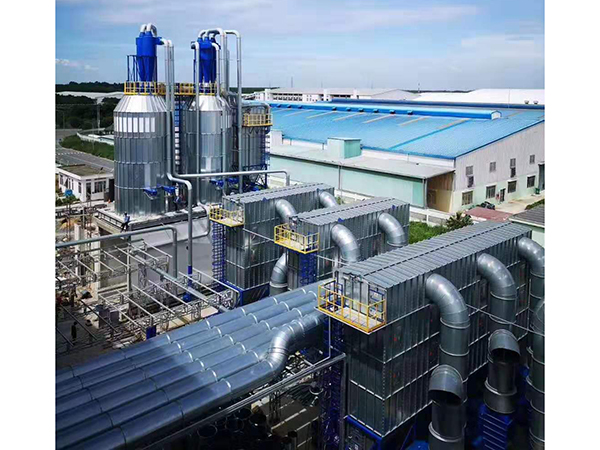
What are the dust removal equipment and methods used in factory workshops?
The cyclone dust collector is generally suitable for handling dust with large particle size and high specific gravity. It has the characteristics of low initial investment, simple operation and management, and convenient dust collection.
The electrostatic precipitator has a high purification efficiency, but it has a high investment cost and a large operating cost.
The purification efficiency of bag-type dust removal is second only to that of electrostatic dust removal. Bag-type dust removal has low energy consumption, no secondary pollution, and high dust removal efficiency. Moreover, it is also easier to clean.
Wet dust removal is suitable for various dust treatment scenarios, with high collection efficiency, low investment cost, low operating cost, and simple operation and management. However, the dust after collection has a relatively high moisture content, which can easily cause secondary pollution. Therefore, this method is generally not used.
Which of those dust removal equipment and methods is the best?
By comparing the above several dust removal technologies and considering the nature of the dust in the workshop, our company suggests using bag-type dust removal technology to handle the dust in the workshop.
The bag-type dust collector effectively overcomes several major problems such as high dust concentration, easy dust generation, easy ignition and explosion, easy blockage, static electricity, and high processing costs. It has five major advantages: "reliability, long service life, low consumption, corrosion resistance, and good appearance". These features greatly meet the needs of enterprises with large production scales and high requirements for production equipment. The MC series bag-type dust collector is made of high-quality filtering materials and has a purification rate of up to 99%. The exhaust gas emission concentration complies with the local standard of Guangdong Province "Limits of Air Pollutants" [DB4427-2001]. The advanced combined design demonstrates the excellent performance of the bag-type dust collector, with a beautiful and elegant appearance. It has a longer service life and significantly lower costs.
The resistance and energy consumption of the ventilation duct system directly affect the ventilation effect. If the duct wind speed is too low, the suction effect will not be obvious and it may even affect the normal operation of the system. When the airflow speed is too high, the pressure loss increases in a square pattern, resulting in a reduction in the volume of the extracted gas. Therefore, the main duct air speed designed by our company is approximately 20 - 25 m/s. The duct is used to connect various equipment in the system and provides a channel for the gas flow. The duct layout should be reasonable, striving for short, straight, and flat. The layout design of the duct is related to the pressure loss of the fluid inside the duct and affects the selection of the fan.
An air hood is a device used to capture harmful gases containing dust. It collects the cover through the movement of air flow and the emitted harmful substances can be directly captured at the location and the diffusion area of the workshop can be controlled to ensure that the concentration of harmful substances in the indoor working area does not exceed the requirements of national health standards. The design of the air hood should take into account the actual environment and the workplace, and be adapted to the workplace. It should maximize the collection of harmful gases and reduce diffusion. According to the air flow mode, pollutant capture devices can be divided into suction type and blowing type. Suction capture devices are divided into two types according to their shape: collector and trap. In closed production equipment, if pollutants occur inside the equipment, through the holes and cracks in the workshop, if micro pressure is allowed to exist in the internal equipment, gas collectors can be used to capture pollutants. If there is no micro negative pressure or surface pollutant pollution sources allowed in the equipment, it can be used to capture the air hood.
There are numerous types of gas collectors, and they are widely used. According to the relative positions of the collection hood, the pollution source and the housing, collection hoods can be classified into three types: closed collection hoods, semi-closed collection hoods and external collection hoods. The external suction hood can be divided into upper suction hood, lower suction hood and side suction hood.
The dust removal system in the workshop is usually composed of a suction hood, ventilation ducts, dust collector, fan, motor, chimney, etc.
About
Introduction Case Company Honor CooperationProduct
Central dust collection (dust collection) system VOCs Waste Gas Treatment System Polishing system dust removal equipment Dust explosion-proof and explosion relief safety system Dust-free spray painting room Painting production line (floor conveyor line, suspended...News
Dynamic information Questionservice
ContactMr. Tian:+86 138-2693-5405

Mobile website
WeChat Official Account
